Pond Electricity Cost Calculator – How Much Does Your Pond Cost to Run?
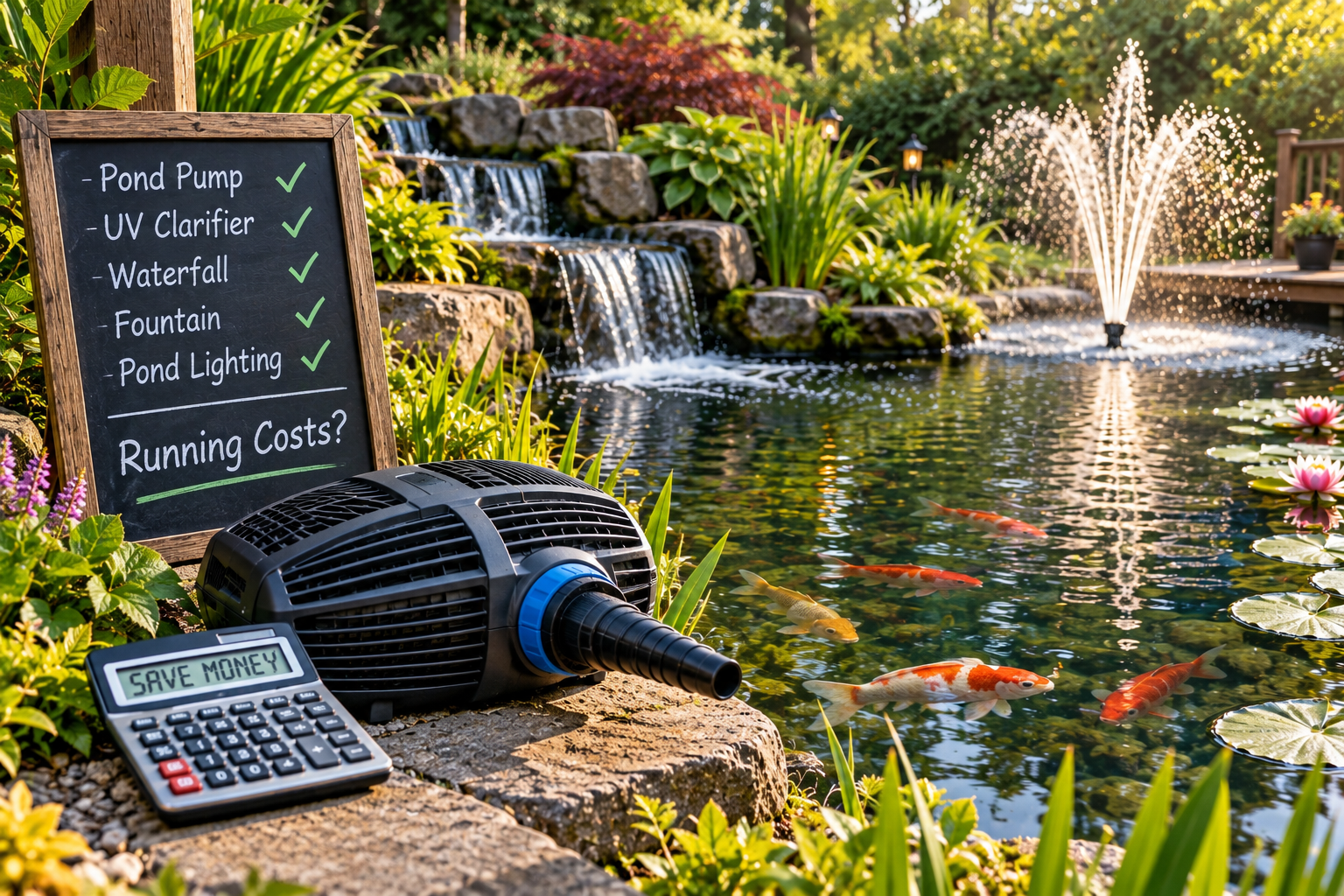
How much does a pond cost to run? Use our free pond electricity calculator to estimate the daily, monthly and annual running cost of your garden or koi pond using your own electricity tariff.
How much does a pond cost to run?
The electricity cost of a garden or koi pond depends on the combined power consumption of all the equipment running on it. This can include the main pond pump, UV clarifier, air pump, waterfall or fountain pump, lighting and other electrical equipment.
Pond equipment that operates continuously can use a surprising amount of electricity over the course of a year. The calculator below lets you add the equipment used on your own pond and calculate the estimated daily, monthly and annual electricity cost using your own electricity tariff.
Pond Electricity Cost Calculator
Estimate what your pond equipment costs to run. All figures are estimates only.
Check your electricity bill for your unit rate in pence per kWh. Standing charges are not included.
Your pond equipment
Estimated pond running cost
Cost breakdown
- Filter pump£96.65/year · 71%
- UV clarifier£38.66/year · 29%
Compare your existing pond pump
Optional. Uses the electricity price entered above.
All figures are estimates based on the values you enter and do not include standing charges, VAT changes or tariff variations. Actual running costs and savings will vary.
How pond electricity costs are calculated
Electrical equipment is normally rated in watts, and electricity is billed in kilowatt-hours (kWh). The calculation is straightforward:
- watts ÷ 1,000 = kilowatts – converts the equipment's power rating into the unit electricity is billed in.
- kilowatts × hours running = kWh – the electricity consumed over the time the equipment operates.
- kWh × electricity price per kWh = running cost – multiplying by your unit rate gives the cost for that equipment.
The important step is to repeat this for every item on the pond and add the results together. The true cost of running a pond is the total of the filter pump, UV clarifier, air pump, waterfall, lighting and anything else — not just the main pump on its own.
Example: calculating the running cost of a complete pond
Here is a worked example using realistic wattages for a moderately stocked garden pond:
- Main filter pump: 45 watts, running 24 hours a day
- UV clarifier: 18 watts, running 24 hours a day in season
- Air pump: 25 watts, running 24 hours a day
- Waterfall pump: 80 watts, running 8 hours a day
Using an example tariff of 25 pence per kWh (an example only — enter your own current electricity rate into the calculator above):
- Filter pump: 0.045 kW × 24 hours × 365 days ≈ 394 kWh ≈ £99 per year
- UV clarifier: 0.018 kW × 24 hours × 365 days ≈ 158 kWh ≈ £39 per year
- Air pump: 0.025 kW × 24 hours × 365 days ≈ 219 kWh ≈ £55 per year
- Waterfall pump: 0.080 kW × 8 hours × 365 days ≈ 234 kWh ≈ £58 per year
That is a combined total of roughly £250 per year for this example pond — a figure that would be easy to underestimate by looking at the filter pump alone. Equipment running 24 hours a day operates for around 8,760 hours per year, so even modest wattages add up to a substantial annual electricity cost when all the devices are combined.
What uses electricity on a garden pond?
- Pond pumps – the filter pump is usually the biggest contributor, as it normally runs continuously.
- UV clarifiers – often run for many hours each day during the pond season to control green water.
- Air pumps – commonly run continuously on koi ponds and heavily stocked fish ponds.
- Waterfalls and fountains – can require surprisingly powerful pumps, particularly where water is lifted through a significant height.
- Pond lighting – modern LED lighting uses relatively little electricity, but operating hours still make a difference.
- Heaters – where used, for example on heated koi ponds, these can be the largest single consumer and should always be included in any running-cost estimate.
Do pond pumps need to run 24 hours a day?
On most established ponds the filtration pump is intended to operate continuously. Biological filters depend on water circulation to supply oxygen to the beneficial bacteria that process fish waste, and stopping the flow for extended periods can reduce the oxygen available to those bacteria and affect filtration performance.
Pond designs do vary — for example some wildlife ponds have no pump at all — so this is a general principle rather than an absolute rule. If you are unsure whether your own filtration can be turned down or placed on a timer, it is worth getting advice before making changes. We cover seasonal considerations in our guide to low oxygen in garden ponds during summer.
How can I reduce pond electricity costs?
There are sensible ways to lower the running cost of a pond without compromising water quality:
- Choose an appropriately sized, efficient pump. Our pond pump buyer's guide explains how to match a pump to your pond and filter.
- Avoid massively oversized pumps. An oversized pump increases both purchase price and electricity consumption unnecessarily.
- Check for unnecessary restriction in pipework. Long runs, tight bends and undersized pipe force pumps to work harder.
- Keep filters and pumps maintained. A clogged pre-filter or blocked impeller reduces efficiency and can increase running costs. Our pond cleaning services page explains what a proper clean involves.
- Consider whether decorative waterfalls and fountains genuinely need to run continuously — they can often be placed on a timer without affecting filtration.
- Compare actual wattage rather than relying only on a claimed maximum pond size when choosing new equipment.
- Calculate the total running cost before purchasing new equipment, using the calculator above with your own tariff.
We would not recommend switching essential biological filtration off overnight simply to save electricity.
Energy-efficient pond pumps
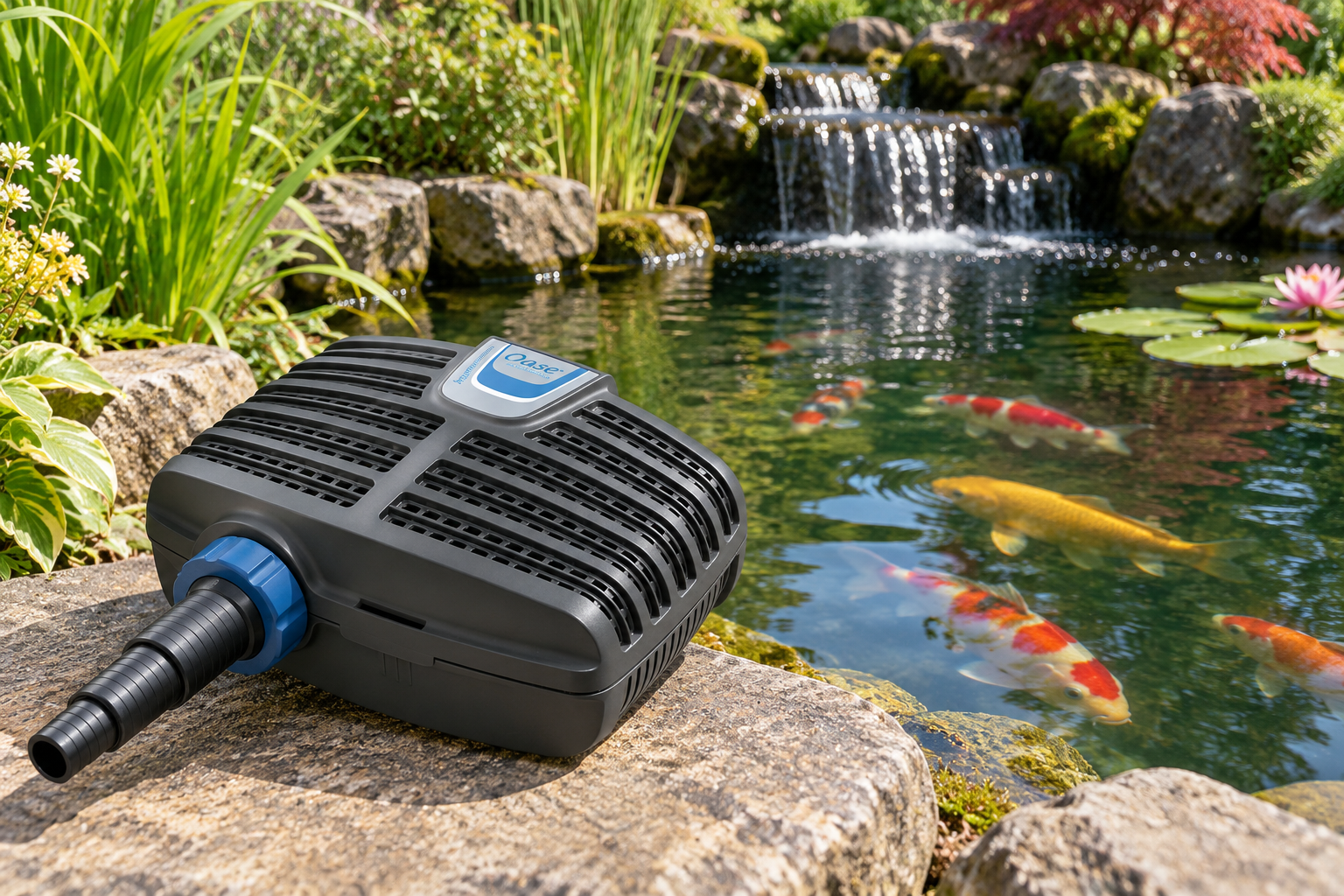
The Oase Aquamax Eco Classic is a good example of an energy-efficient pond filter pump. It is designed for continuous pond circulation and is available in different sizes to suit different ponds and filtration systems. The important thing is to choose the correct model rather than simply buying the largest pump available. You can also compare your existing pump against a replacement using the comparison tool in the calculator above — enter both wattages and it will estimate the annual saving using your own tariff. For a filter-side option on smaller ponds, see our Oase Filtral UVC 9000 review.
A note on real-world running costs
At Aquatic Specialist, we maintain and work on garden ponds and koi ponds in real-world conditions, where the total running cost depends on the complete system rather than a single pump. If you would like help assessing your pond's equipment, our pond maintenance services cover everything from pumps and filtration to seasonal care.
Please note these calculator results are estimates. Actual electricity consumption and costs will vary according to your equipment, operating times and electricity tariff.
Products We've Mentioned & Recommend
Below you'll find a selection of products we've mentioned in this article, along with a few others we think you might find useful. We've included Amazon links to make them easy to find.
A quick word about affiliate links...
Some of these links are affiliate links, which means we may earn a small commission from qualifying purchases, at no extra cost to you.
Unfortunately, the commission doesn't quite stretch to cocktails on a yacht or a garage full of sports cars. In reality, it helps cover the running costs of this website and, with a bit of luck, might eventually buy me a new pair of waders that don't leak!
We only recommend products we genuinely believe are worth considering, and your support helps us keep sharing free advice from our years of working with aquariums and ponds.
Thanks for supporting Aquatic Specialist!
As an Amazon Associate I earn from qualifying purchases.
Oase
Oase Aquamax Eco Classic 11500 Pond Pump
Best for: Medium to large koi and garden ponds
As an Amazon Associate, we earn from qualifying purchases.