Nerite Snails: A Guide to Keeping Them in Planted Aquariums
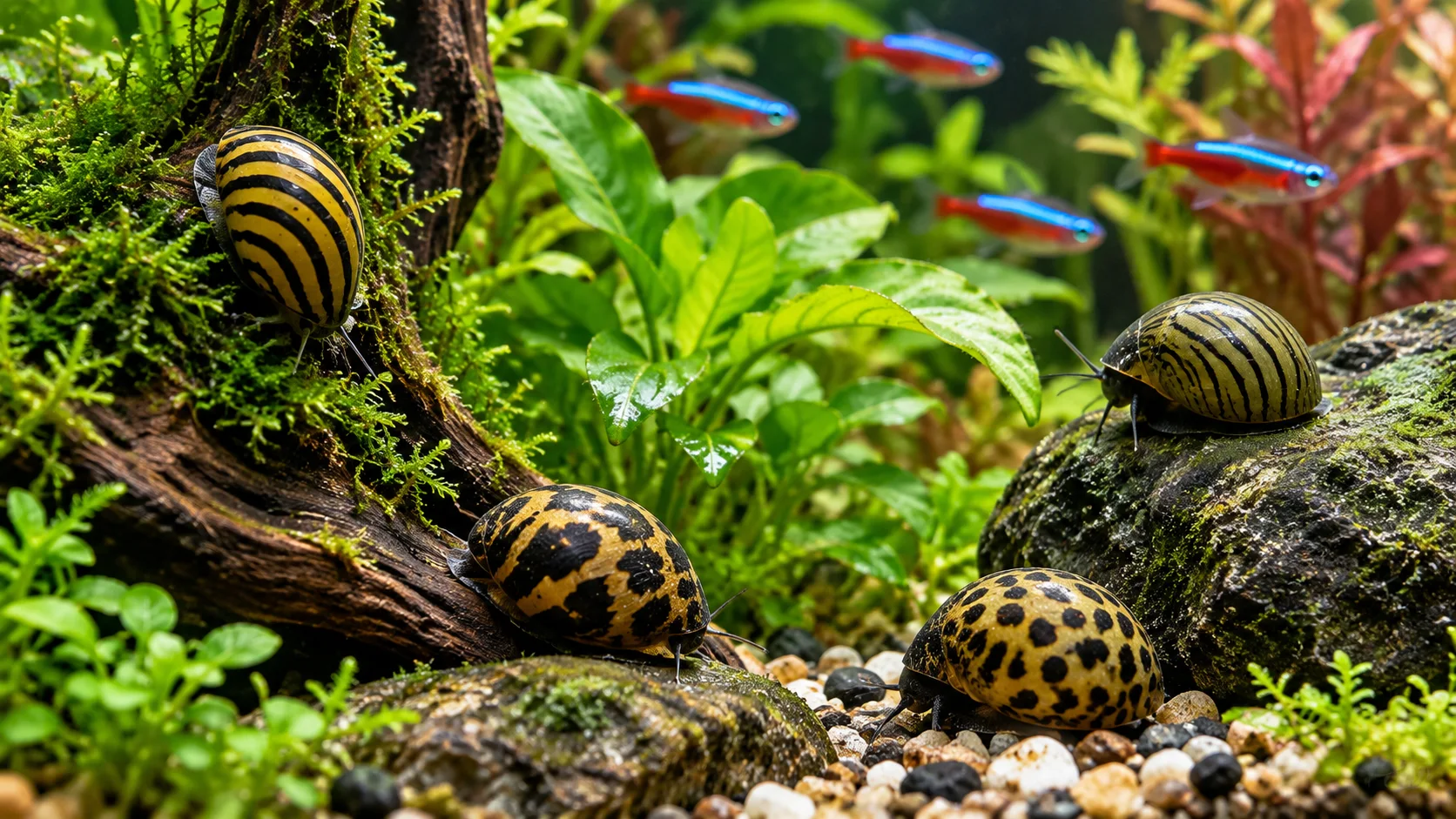
Nerite snails are small, peaceful algae grazers that we often use in planted client aquariums. They can help keep glass, rocks, driftwood and plant leaves clean without damaging healthy plants. This guide covers their care, feeding, tank mates, breeding and the potential drawbacks to consider.
Nerite snails are one of our preferred algae grazers for planted freshwater aquariums. We often use them in client aquariums, particularly where we want something small and peaceful that will continually graze algae from glass, rocks, wood and plant leaves without damaging healthy plants.
They can be particularly useful in smaller planted aquariums where adding a larger algae-eating fish isn't appropriate. A couple of Nerite snails add very little to the overall stocking level, yet they can spend an impressive amount of time working their way around the aquarium.
One of their other major advantages is that, although they may lay eggs, Nerite snails won't normally establish a breeding population in a freshwater aquarium. This makes them very different from some of the pest snails that can rapidly multiply once introduced.
They aren't a complete solution to algae, though, and there are a few things worth knowing before adding them.
What are Nerite snails?
Nerite snail is a general term covering several related species and varieties that appear in the aquarium trade.
You'll commonly see names such as Zebra Nerite, Tiger Nerite, Olive Nerite and Horned Nerite. Shell patterns vary considerably, which is part of their appeal. Some have striking black and yellow stripes, while others have spots, bands or small projections from the shell.
Most remain relatively small, making them well suited to community and planted aquariums.
Like other snails, they use a specialised feeding structure called a radula to scrape food from surfaces. In an aquarium, much of their day is spent slowly travelling across glass, rocks, wood and plants grazing algae and biofilm.
Why we use Nerite snails in planted aquariums
We've used Nerite snails in numerous client aquariums, and planted tanks are where we find them particularly useful.
Their main advantage is that they're extremely unobtrusive. They don't chase fish, dig through the substrate or grow into large animals. Instead, they quietly move around the aquarium grazing surfaces.
This can be especially useful on slow-growing plants such as Anubias. Their broad leaves often develop algae, particularly when they're exposed to relatively strong lighting. Nerites can graze across these leaves without normally damaging the healthy plant tissue underneath.
We also like using them on aquariums containing decorative rocks and driftwood. These surfaces naturally develop biofilm and algae and provide plenty of grazing opportunities.
That doesn't mean we introduce Nerites to every planted aquarium. There needs to be enough natural food available to support them.
Are Nerite snails good algae eaters?
Nerites are excellent algae grazers, but it's important to have realistic expectations.
They're particularly useful for algae and biofilm growing directly on hard surfaces. Glass, stones and aquarium decoration can often look noticeably cleaner after a Nerite has passed across them.
Brown diatoms and softer green algae are commonly grazed, and Nerites can also tackle some harder surface growth.
What they won't do is solve every algae problem.
If an aquarium is covered in long hair algae, for example, adding Nerite snails isn't likely to make the problem disappear. Similarly, if excessive lighting, poor maintenance or an imbalance of nutrients is driving persistent algae growth, that underlying issue still needs correcting.
We regard Nerites as part of an aquarium's clean-up crew rather than a substitute for proper aquarium maintenance.
Feeding Nerite snails
This is an area that's sometimes overlooked.
People often buy Nerites because their aquarium has plenty of algae. The snails then do exactly what they're supposed to do and gradually reduce it.
Eventually there may not be enough natural food left to support a large number of snails.
This is one reason we prefer introducing relatively small numbers. In many planted client aquariums, one or two Nerites can be enough to provide useful additional grazing.
Mature aquariums are particularly suitable because rocks, plants and driftwood continually develop small amounts of algae and biofilm.
Algae wafers and other vegetable-based sinking foods can be offered as supplementary food, although individual Nerites don't always show the same enthusiasm for prepared foods.
The important thing is not to assume that a snail can survive indefinitely in an aquarium simply because it originally contained algae.
Water conditions and shell health
Nerite snails prefer stable, clean water and benefit from having sufficient minerals available for shell development.
Very soft, acidic water can cause problems over time because their shells rely on calcium and other minerals. Shell erosion, pitting and deterioration can occur when conditions aren't suitable.
We therefore wouldn't look only at temperature and pH when deciding whether an aquarium is appropriate. Water hardness is also worth considering.
As with the fish in the aquarium, ammonia and nitrite should remain at zero and regular water changes should continue as normal.
It's also important to be careful when using aquarium medications.
Some treatments, particularly those containing copper, can be dangerous to snails and other invertebrates. Always check whether a treatment is suitable for an aquarium containing invertebrates before using it.
Will Nerite snails breed in freshwater?
One of the reasons we prefer Nerites over many other aquarium snails is that they won't normally reproduce successfully in freshwater.
Females can still lay eggs, and this occasionally surprises people who specifically bought Nerites because they were told they wouldn't breed.
The difference is that the eggs don't normally develop into baby snails in a freshwater aquarium. Successful development of commonly kept Nerites involves a brackish or marine stage.
As a result, you're not likely to add two Nerites and discover hundreds of snails a few months later.
There is, however, a downside.
Nerite eggs appear as small, hard white capsules and can be deposited on rocks, driftwood, equipment and sometimes the aquarium glass. They can be quite noticeable, particularly on dark wood.
This is probably the main aesthetic disadvantage of keeping them in carefully aquascaped display tanks.
Nerite snails and aquarium plants
Healthy aquarium plants are generally safe with Nerite snails.
When you see a Nerite apparently eating a leaf, it's normally grazing algae and biofilm from the surface rather than consuming the plant itself.
This is one of the reasons we use them in planted aquariums. They can move across broad leaves and into areas that would otherwise need to be cleaned manually.
A well-planted aquarium also provides more surface area for grazing and shelter, making it a particularly natural environment for them.
Suitable tank mates
Nerite snails are completely peaceful, so the main question is whether the other inhabitants will leave the snails alone.
They work well in peaceful community aquariums containing fish such as small tetras, rasboras, Corydoras and Otocinclus. They can also be kept alongside Amano shrimp and many smaller freshwater shrimp.
Snail-eating fish are obviously unsuitable.
Some loaches and puffers are capable of attacking snails and shouldn't be combined with Nerites if you expect the snails to survive.
Watch for escaping snails
One unusual habit worth mentioning is that Nerites sometimes leave the water.
We've occasionally found them above the waterline, and they can potentially climb completely out of an uncovered aquarium.
A fitted lid makes this much less of a problem.
If you do find one outside the aquarium, don't immediately assume it's dead. Nerites can survive out of water for a while, particularly if they haven't dried out completely.
How many should you keep?
There isn't a fixed number of Nerite snails that every aquarium needs.
We prefer to start conservatively.
For a smaller planted aquarium, one or two may be perfectly adequate. A larger mature aquarium with plenty of rocks, wood and natural algae can support more.
The available food matters more than simply calculating a number based on litres.
Adding ten snails because an aquarium currently has algae can result in ten hungry snails once they've eaten most of it.
Final thoughts
Nerite snails are one of the few aquarium snails we actively use as part of the clean-up crew in planted client aquariums.
They're small, peaceful, attractive and particularly good at grazing algae from glass, rocks, driftwood and plant leaves. Importantly, they also won't establish an exploding population in a normal freshwater aquarium.
They do have their drawbacks. Their white eggs can be unsightly, they sometimes climb out of uncovered tanks and they need sufficient food and minerals to remain healthy.
Used in sensible numbers, however, they're an excellent addition to many mature planted aquariums.
We tend to see them as a useful supporting member of the aquarium rather than an answer to an algae problem. Combine a small number of Nerites with sensible lighting, regular maintenance and good water quality, and they'll quietly spend their days doing what they do best: grazing. Snails: A Guide to Keeping Them in Planted Aquariums
Nerite snails are one of our preferred algae grazers for planted freshwater aquariums. We often use them in client aquariums, particularly where we want something small and peaceful that will continually graze algae from glass, rocks, wood and plant leaves without damaging healthy plants.
They can be particularly useful in smaller planted aquariums where adding a larger algae-eating fish isn't appropriate. A couple of Nerite snails add very little to the overall stocking level, yet they can spend an impressive amount of time working their way around the aquarium.
One of their other major advantages is that, although they may lay eggs, Nerite snails won't normally establish a breeding population in a freshwater aquarium. This makes them very different from some of the pest snails that can rapidly multiply once introduced.
They aren't a complete solution to algae, though, and there are a few things worth knowing before adding them.
What are Nerite snails?
Nerite snail is a general term covering several related species and varieties that appear in the aquarium trade.
You'll commonly see names such as Zebra Nerite, Tiger Nerite, Olive Nerite and Horned Nerite. Shell patterns vary considerably, which is part of their appeal. Some have striking black and yellow stripes, while others have spots, bands or small projections from the shell.
Most remain relatively small, making them well suited to community and planted aquariums.
Like other snails, they use a specialised feeding structure called a radula to scrape food from surfaces. In an aquarium, much of their day is spent slowly travelling across glass, rocks, wood and plants grazing algae and biofilm.
Why we use Nerite snails in planted aquariums
We've used Nerite snails in numerous client aquariums, and planted tanks are where we find them particularly useful.
Their main advantage is that they're extremely unobtrusive. They don't chase fish, dig through the substrate or grow into large animals. Instead, they quietly move around the aquarium grazing surfaces.
This can be especially useful on slow-growing plants such as Anubias. Their broad leaves often develop algae, particularly when they're exposed to relatively strong lighting. Nerites can graze across these leaves without normally damaging the healthy plant tissue underneath.
We also like using them on aquariums containing decorative rocks and driftwood. These surfaces naturally develop biofilm and algae and provide plenty of grazing opportunities.
That doesn't mean we introduce Nerites to every planted aquarium. There needs to be enough natural food available to support them.
Are Nerite snails good algae eaters?
Nerites are excellent algae grazers, but it's important to have realistic expectations.
They're particularly useful for algae and biofilm growing directly on hard surfaces. Glass, stones and aquarium decoration can often look noticeably cleaner after a Nerite has passed across them.
Brown diatoms and softer green algae are commonly grazed, and Nerites can also tackle some harder surface growth.
What they won't do is solve every algae problem.
If an aquarium is covered in long hair algae, for example, adding Nerite snails isn't likely to make the problem disappear. Similarly, if excessive lighting, poor maintenance or an imbalance of nutrients is driving persistent algae growth, that underlying issue still needs correcting.
We regard Nerites as part of an aquarium's clean-up crew rather than a substitute for proper aquarium maintenance.
Feeding Nerite snails
This is an area that's sometimes overlooked.
People often buy Nerites because their aquarium has plenty of algae. The snails then do exactly what they're supposed to do and gradually reduce it.
Eventually there may not be enough natural food left to support a large number of snails.
This is one reason we prefer introducing relatively small numbers. In many planted client aquariums, one or two Nerites can be enough to provide useful additional grazing.
Mature aquariums are particularly suitable because rocks, plants and driftwood continually develop small amounts of algae and biofilm.
Algae wafers and other vegetable-based sinking foods can be offered as supplementary food, although individual Nerites don't always show the same enthusiasm for prepared foods.
The important thing is not to assume that a snail can survive indefinitely in an aquarium simply because it originally contained algae.
Water conditions and shell health
Nerite snails prefer stable, clean water and benefit from having sufficient minerals available for shell development.
Very soft, acidic water can cause problems over time because their shells rely on calcium and other minerals. Shell erosion, pitting and deterioration can occur when conditions aren't suitable.
We therefore wouldn't look only at temperature and pH when deciding whether an aquarium is appropriate. Water hardness is also worth considering.
As with the fish in the aquarium, ammonia and nitrite should remain at zero and regular water changes should continue as normal.
It's also important to be careful when using aquarium medications.
Some treatments, particularly those containing copper, can be dangerous to snails and other invertebrates. Always check whether a treatment is suitable for an aquarium containing invertebrates before using it.
Will Nerite snails breed in freshwater?
One of the reasons we prefer Nerites over many other aquarium snails is that they won't normally reproduce successfully in freshwater.
Females can still lay eggs, and this occasionally surprises people who specifically bought Nerites because they were told they wouldn't breed.
The difference is that the eggs don't normally develop into baby snails in a freshwater aquarium. Successful development of commonly kept Nerites involves a brackish or marine stage.
As a result, you're not likely to add two Nerites and discover hundreds of snails a few months later.
There is, however, a downside.
Nerite eggs appear as small, hard white capsules and can be deposited on rocks, driftwood, equipment and sometimes the aquarium glass. They can be quite noticeable, particularly on dark wood.
This is probably the main aesthetic disadvantage of keeping them in carefully aquascaped display tanks.
Nerite snails and aquarium plants
Healthy aquarium plants are generally safe with Nerite snails.
When you see a Nerite apparently eating a leaf, it's normally grazing algae and biofilm from the surface rather than consuming the plant itself.
This is one of the reasons we use them in planted aquariums. They can move across broad leaves and into areas that would otherwise need to be cleaned manually.
A well-planted aquarium also provides more surface area for grazing and shelter, making it a particularly natural environment for them.
Suitable tank mates
Nerite snails are completely peaceful, so the main question is whether the other inhabitants will leave the snails alone.
They work well in peaceful community aquariums containing fish such as small tetras, rasboras, Corydoras and Otocinclus. They can also be kept alongside Amano shrimp and many smaller freshwater shrimp.
Snail-eating fish are obviously unsuitable.
Some loaches and puffers are capable of attacking snails and shouldn't be combined with Nerites if you expect the snails to survive.
Watch for escaping snails
One unusual habit worth mentioning is that Nerites sometimes leave the water.
We've occasionally found them above the waterline, and they can potentially climb completely out of an uncovered aquarium.
A fitted lid makes this much less of a problem.
If you do find one outside the aquarium, don't immediately assume it's dead. Nerites can survive out of water for a while, particularly if they haven't dried out completely.
How many should you keep?
There isn't a fixed number of Nerite snails that every aquarium needs.
We prefer to start conservatively.
For a smaller planted aquarium, one or two may be perfectly adequate. A larger mature aquarium with plenty of rocks, wood and natural algae can support more.
The available food matters more than simply calculating a number based on litres.
Adding ten snails because an aquarium currently has algae can result in ten hungry snails once they've eaten most of it.
Final thoughts
Nerite snails are one of the few aquarium snails we actively use as part of the clean-up crew in planted client aquariums.
They're small, peaceful, attractive and particularly good at grazing algae from glass, rocks, driftwood and plant leaves. Importantly, they also won't establish an exploding population in a normal freshwater aquarium.
They do have their drawbacks. Their white eggs can be unsightly, they sometimes climb out of uncovered tanks and they need sufficient food and minerals to remain healthy.
Used in sensible numbers, however, they're an excellent addition to many mature planted aquariums.
We tend to see them as a useful supporting member of the aquarium rather than an answer to an algae problem. Combine a small number of Nerites with sensible lighting, regular maintenance and good water quality, and they'll quietly spend their days doing what they do best: grazing.