Low-Tech vs High-Tech Aquascaping: Which Approach Suits You?
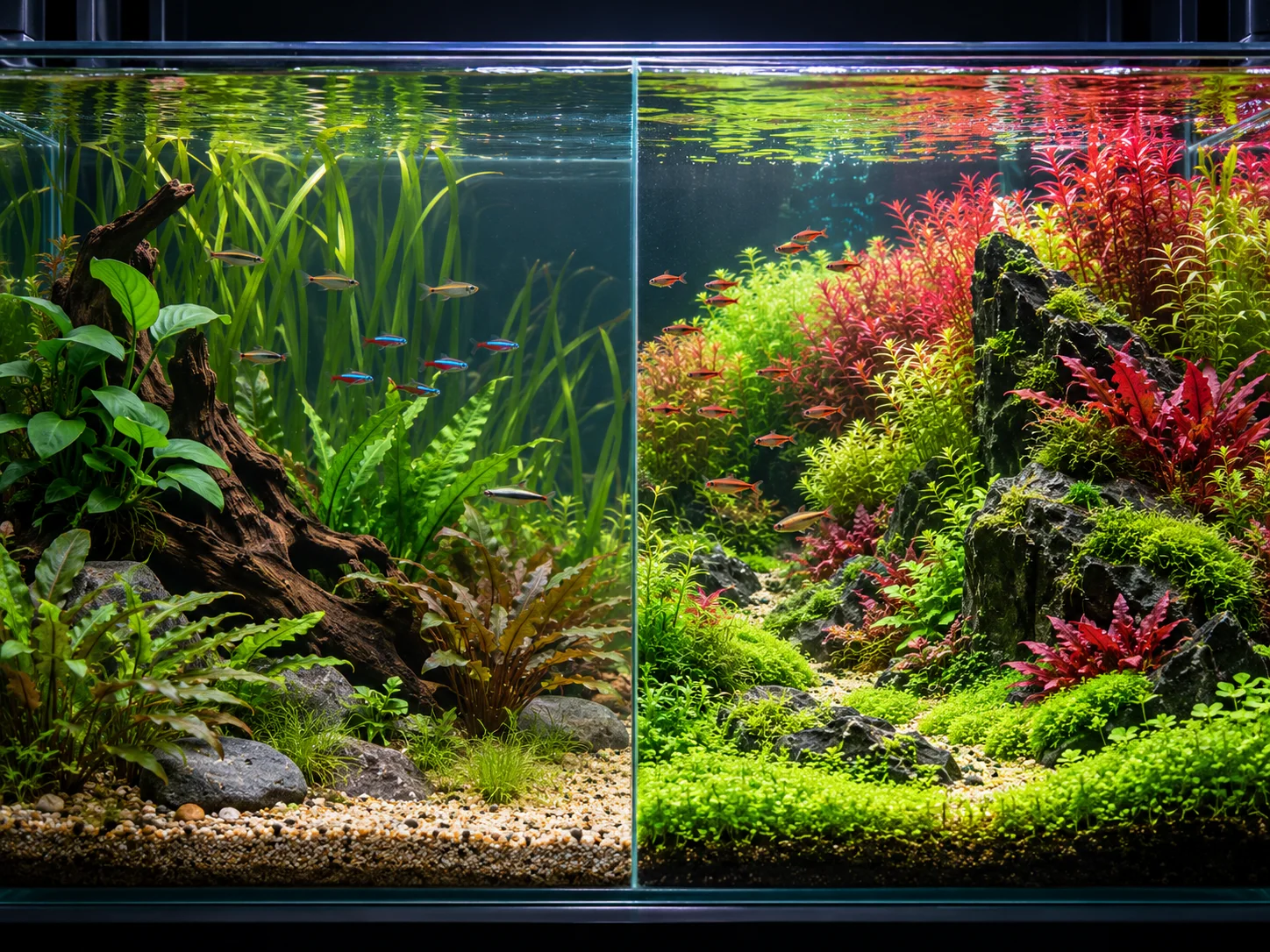
Low-tech and high-tech planted aquariums can both produce excellent results. This guide compares CO₂, lighting, plant choice, maintenance and cost to help you decide which approach best suits your aquarium.
There are two broad ways to approach a planted aquarium. At one end is the low-tech planted tank, where relatively modest lighting, carefully chosen plants and straightforward maintenance are used to create an attractive aquarium without injected CO₂. At the other is the high-tech aquascape, where stronger lighting, pressurised CO₂ and more precise fertilisation are used to push plant growth much harder.
Neither approach is automatically better. They simply suit different aquariums and different aquarists.
We regularly work with planted aquariums, and one thing that becomes obvious quite quickly is that more equipment does not automatically produce a better aquarium. Some very simple planted tanks can look excellent for years, while technically advanced aquascapes can quickly become difficult to manage if the balance between lighting, nutrients and CO₂ is not right.
The best approach is normally the one that produces the type of aquarium you want while still fitting comfortably into the amount of maintenance you are prepared to do.
What is a low-tech planted aquarium?
A low-tech aquarium generally uses moderate lighting without pressurised CO₂ injection. Plants rely on the carbon dioxide naturally present in the aquarium along with nutrients supplied by fish waste, the substrate and, where necessary, fertilisers.
Plants such as Anubias, Java fern, Cryptocoryne, Vallisneria and Amazon swords are particularly well suited to this type of setup. Many mosses and easier stem plants can also grow perfectly well without additional CO₂.
Growth tends to be slower than it would be in a high-tech aquarium, but that is not necessarily a disadvantage.
Slower growth means less trimming, less frequent replanting and a planted aquarium that can remain relatively stable for long periods.
For many of the client aquariums we work with, this is actually an advantage. The aquarium still has the appearance of a heavily planted display, but it does not require constant attention simply to keep the plants under control.
Low-tech does not mean maintenance-free
One mistake is assuming that a low-tech aquarium can simply be planted and forgotten.
Plants still need suitable nutrients, lighting and regular aquarium maintenance. Old or damaged leaves need removing, overgrown plants will eventually need trimming and the filter still requires normal servicing.
Lighting also needs to be appropriate.
Adding extremely powerful lighting to a low-tech aquarium does not necessarily make the plants grow better. Plants need light, nutrients and carbon in reasonable balance. If you dramatically increase one while the others remain limited, algae can take advantage of the excess.
For that reason, relatively moderate lighting often works particularly well in low-tech planted aquariums.
The objective is not to force the maximum amount of growth possible. It is to create steady, healthy growth that can be maintained over the long term.
What makes a high-tech aquascape different?
The major difference is normally pressurised CO₂ injection.
Aquatic plants need carbon to produce new growth. Adding carbon dioxide directly to the aquarium significantly increases the amount available to them, allowing plants to photosynthesise and grow much more efficiently.
Once additional CO₂ is available, stronger lighting can be used and fertilisation can be increased to support the faster growth.
This opens up a much larger range of planting possibilities.
Some demanding Rotala varieties, colourful Ludwigia species and carpeting plants can look dramatically different when grown under good lighting with stable CO₂. Growth can become denser, internodal spacing shorter and colours much stronger.
Carpeting plants that might struggle to form a dense foreground in a low-tech aquarium can spread rapidly under the right high-tech conditions.
For somebody primarily interested in aquascaping rather than simply keeping a planted community aquarium, this level of control can be very appealing.
High-tech aquariums grow quickly
The advantage of faster growth is also one of the main disadvantages.
Plants do not stop growing when the aquascape looks perfect.
Stem plants may need frequent trimming and replanting. Carpeting plants can become excessively thick and need thinning. Faster-growing plants can shade slower species below them, while nutrient consumption increases significantly.
A well-established high-tech aquarium can therefore require considerably more hands-on maintenance than a typical low-tech tank.
There is also less room for inconsistency.
If the lighting remains strong but CO₂ delivery suddenly changes, plants can quickly become stressed. This can give algae an opportunity to establish.
The same applies to fertilisation. Rapidly growing plants consume nutrients much faster, so deficiencies can become noticeable much sooner.
High-tech aquascaping is therefore not necessarily difficult, but it rewards regularity.
CO₂ is usually the biggest decision
Aquariums do not actually fall neatly into two categories.
There is a large middle ground between a very simple planted aquarium and a competition-style high-tech aquascape.
You might use a quality planted substrate, good LED lighting and regular liquid fertilisation without adding CO₂. Alternatively, you might use pressurised CO₂ alongside relatively moderate lighting simply to improve plant growth rather than trying to achieve maximum growth rates.
This is often a very sensible approach.
The important question is what you actually want the aquarium to look like.
If your aim is a natural planted display containing Cryptocoryne, Java fern, Anubias and Vallisneria, there may be very little reason to install a complicated CO₂ system.
If you want a dense Monte Carlo carpet, strongly coloured stem plants and carefully shaped groups of Rotala, adding CO₂ becomes considerably more useful.
The difference in cost
Low-tech planted aquariums are generally cheaper to set up and operate.
Once you have suitable lighting, substrate and plants, there may be relatively little additional specialist equipment to buy.
High-tech aquascaping usually requires a CO₂ cylinder, regulator, solenoid, tubing and diffuser or reactor. The CO₂ cylinder will also eventually need replacing or refilling.
More powerful lighting can increase electricity use and faster-growing plants may require more fertiliser.
None of these individual costs are necessarily excessive, particularly on a single aquarium, but they do make high-tech systems more expensive and more complicated.
There are also simply more components capable of failing.
For anyone who values reliability and simplicity, that is worth considering before installing additional equipment.
Plant choice matters more than technology
One of the easiest ways to create a successful planted aquarium is to choose plants that suit the system rather than trying to force unsuitable plants to grow.
A low-tech aquarium filled with healthy Cryptocoryne, Anubias, Java fern, mosses and Vallisneria will generally look far better than a high-tech aquarium full of struggling demanding species.
Good plant selection can also create surprisingly sophisticated aquascapes without CO₂.
Anubias and Bucephalandra can be attached to wood and rocks, Cryptocoryne can provide dense midground planting and Vallisneria can produce height and movement towards the rear of the aquarium.
Different leaf shapes, colours and textures can still create considerable visual interest.
High-tech aquascaping simply expands the range of plants and styles available.
Which approach requires more skill?
Both approaches require some understanding of plant growth, but the consequences of mistakes tend to appear faster in a high-tech aquarium.
A slowly growing low-tech tank is generally more forgiving.
If fertilisation is slightly inconsistent or a water change happens a few days late, relatively little may change.
In a high-tech aquarium, stronger lighting and faster plant growth mean conditions can change more quickly.
That makes observation particularly important.
You need to recognise when plants are growing differently, when CO₂ distribution is poor or when a particular species is starting to struggle.
For some aquarists, that is part of the enjoyment. Managing the aquarium becomes similar to maintaining an underwater garden.
Others would prefer the aquarium to require less involvement.
Think about the aquarium you want to maintain
This is probably the most important part of the decision.
It is easy to look at photographs of highly manicured aquascapes and decide that you want the same thing at home.
What photographs rarely show is the maintenance required to keep them looking that way.
If you enjoy trimming plants, replanting stems, adjusting fertilisation and experimenting with different species, a high-tech aquarium can be extremely rewarding.
If you would rather perform normal aquarium maintenance and occasionally trim the plants when they become overgrown, low-tech is likely to be more appropriate.
Neither approach is less serious or less attractive.
They simply involve different levels of intervention.
Starting simple can make sense
For somebody creating their first planted aquarium, there is a strong argument for starting relatively simply.
Choose suitable plants, use decent lighting and provide appropriate nutrition. Allow the aquarium to establish and learn how the plants respond.
You can always add CO₂ later.
If the aquarium already looks good and the plants are growing well, you may decide that you do not need anything more complicated.
If you eventually want to grow more demanding species or create dense carpets and strongly coloured stem plants, the aquarium can then be upgraded.
Taking this route also means you understand how the aquarium behaves before increasing the growth rate.
Which approach suits you?
If you want a planted aquarium that is relatively inexpensive, stable and straightforward to maintain, low-tech aquascaping is difficult to beat.
It works particularly well for community aquariums where plants are an important part of the display but fish remain the main focus.
High-tech aquascaping makes more sense when growing and shaping plants is one of the main reasons you keep the aquarium. CO₂ and stronger lighting give you far more control and allow you to grow species that would otherwise be difficult, but they also increase the amount of maintenance required.
There is also nothing wrong with sitting somewhere between the two.
A planted aquarium does not need to fit neatly into a category.
What matters is creating a system that suits the plants you want to grow and the amount of time you genuinely want to spend maintaining it.
The most successful planted aquarium is rarely the one with the most equipment. It is the one that remains healthy, manageable and enjoyable long after the initial excitement of setting it up has passed.